
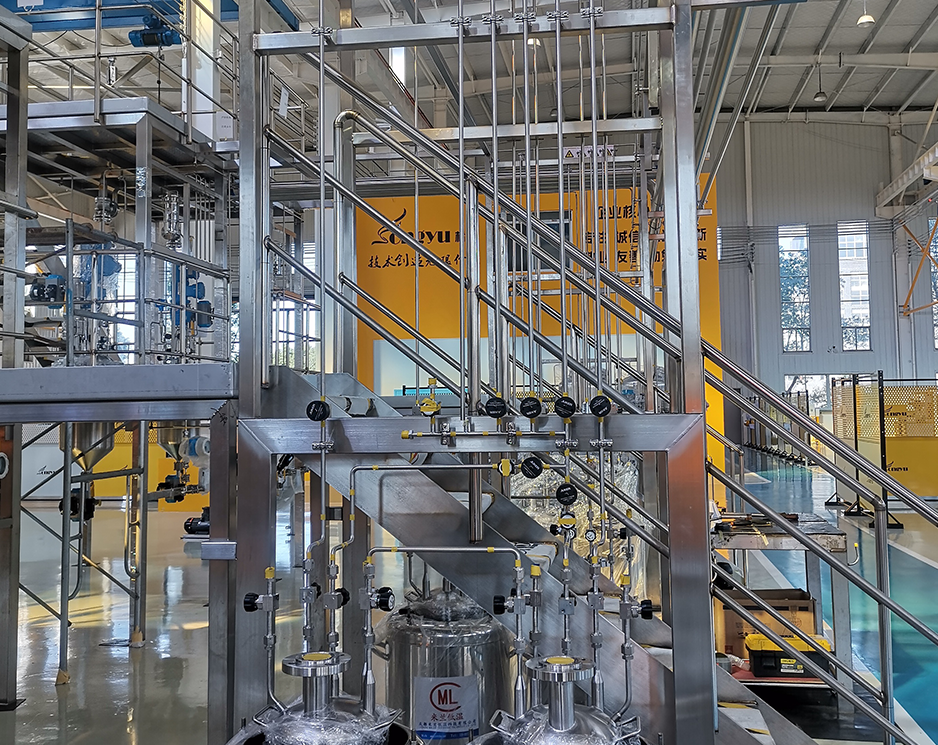
Application: Semiconductor industry (synthesis of precursors, high-purity specialty gases, electronic chemicals, etc.)
Equipment structure: Open top type, internal polishing requires optional BA, EP or lining/spraying PFA, PTFE, with jacket and insulation
Heat exchange: The outer jacket can meet the heating or cooling requirements by passing cold and hot media, with a temperature control accuracy of ± 1 ℃
Mixing: We can provide mechanical mixing, magnetic mixing, and bottom magnetic mixing, depending on the specific working conditions
After integration, it can achieve functions such as automatic feeding, automatic metering, automatic mixing, automatic temperature control, automatic pressure control, automatic discharge, online monitoring, etc
Equipment Material: Available in 304, 316L, 2507, TA2, 904L, etc
Customizable Capacity: 10L~120000L
Pipe connection methods: flange type, flange type, card type
Leakage rate: meets helium detection requirements of 1 * 10-9pa * m3/s
Special equipment requirements: Class I, Class II
Applicable working conditions: gas-liquid, solid-liquid, liquid-liquid droplet addition reaction, temperature -60~425 ℃, pressure -0.1~10MPa
Removable insulation is installed at the upper head and equipment flange for easy maintenance, and the upper head can be equipped with a heat tracing strip;
The pipe mouth cut-off valve is directly welded to the kettle body connection to minimize the risk of leakage as much as possible
The top discharge method of inserting the bottom pipe reduces the dead zone of bottom heat tracing and minimizes the risk of bottom valve leakage
Adopting an integral jacket design, the temperature of the entire kettle wall is more uniform, and there are fewer jacket welds, resulting in a lower risk of leakage
The inner surface adopts electrolytic polishing technology, and the roughness can reach below 0.2um, with less material hanging on the wall
The agitator has undergone CFD flow field simulation, making blade selection more targeted
Mixing configuration online magnetic sensor, real-time monitoring of mixing speed. If magnetic stirring is used, it can detect magnetic attenuation



安徽松羽科技集团有限公司 备案编号:皖ICP备17015190号 版权所有Copyright©2025 All Right Reserve


 WeChat Customer Service


 Contact us
